
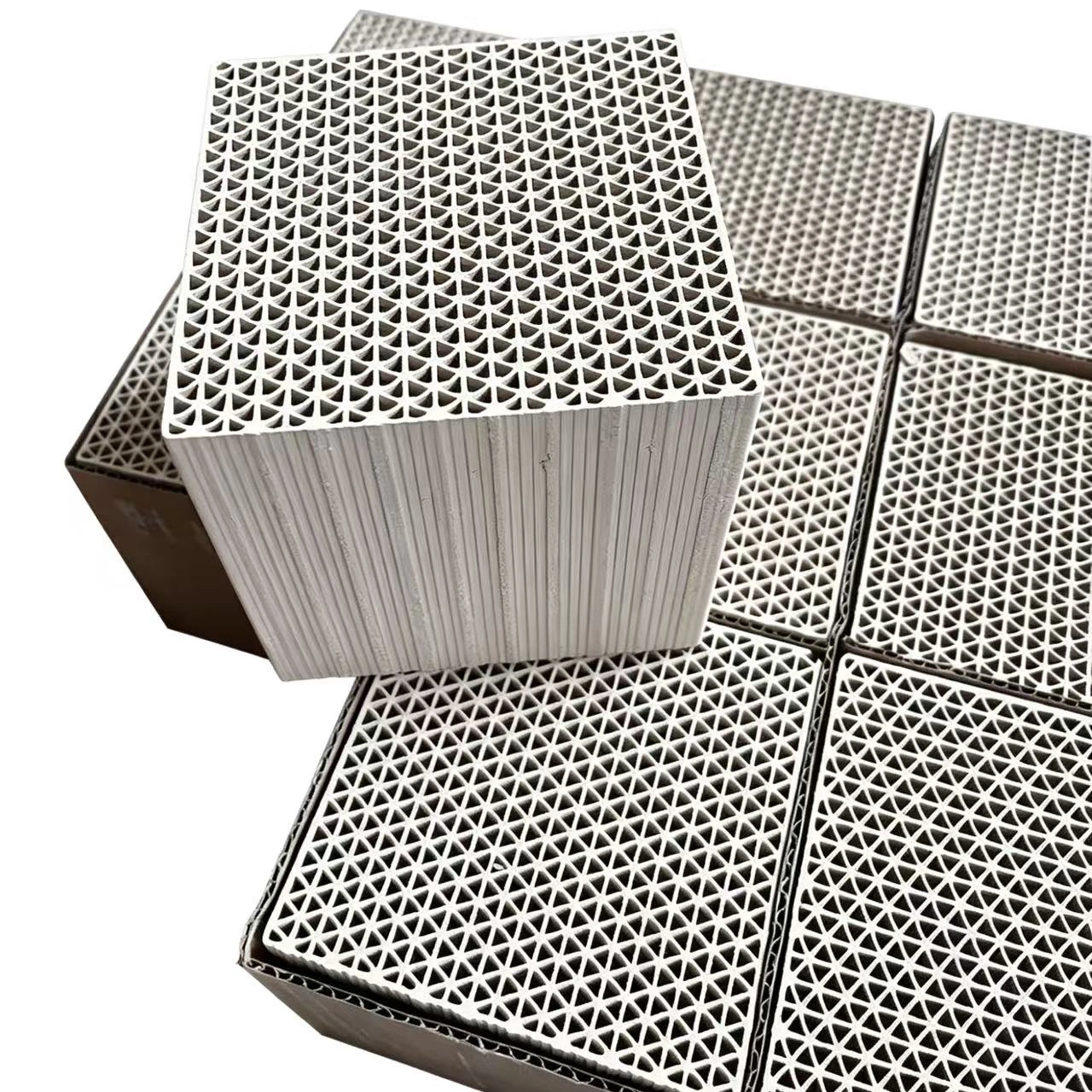
Honeycomb zeolite molecular sieve
The main material of honeycomb zeolite adsorbent is natural zeolite, which is an inorganic microporous material composed of sio2, al2o3, and alkaline or alkaline-earth metals. Its internal pore volume accounts for 40-50% of the total volume, and its specific surface area is 100-500 m2/g. It has characteristics such as high temperature resistance and non-flammability.
Honeycomb zeolite molecular sieve, zeolite molecular sieve, honeycomb-like zeolite molecular sieve
Specification: 100x100x100mm
Product Introduction
The main material of honeycomb zeolite adsorbent is natural zeolite, which is an inorganic microporous material composed of sio2, al2o3, and alkaline or alkaline-earth metals. Its internal pore volume accounts for 40-50% of the total volume, and its specific surface area is 100-500 m2/g. It has characteristics such as high temperature resistance, non-flammability, good thermal stability, and hydrothermal stability. It is an efficient molecular sieve carrier with good adsorption performance, no secondary pollution, and high temperature regeneration capability. Compared to honeycomb activated carbon, its performance is about 25% of its efficiency. However, it has characteristics such as high temperature resistance and low ignition tendency, making it widely used in adsorption, separation, catalysis, and environmental fields. It is more suitable for the treatment of organic waste gases with high air volume and low concentration.
Zeolite adsorbent products include: microporous adsorbent, mesoporous adsorbent, honeycomb zeolite molecular sieve, honeycomb-like zeolite molecular sieve, and zeolite honeycomb molecular sieve
(1) Molecular sieves with a pore diameter below 2 nm are classified as microporous molecular sieves, while those with a pore diameter ranging from 2 to 50 nm are mesoporous molecular sieves (those above 50 nm are classified as macroporous molecular sieves). Mesoporous molecular sieves possess characteristics such as extremely high specific surface area, regularly ordered pore structure, narrow pore size distribution, and continuously adjustable pore size, making them play a significant role in the adsorption, separation, and catalytic reactions of large molecules, which are difficult to achieve with microporous molecular sieves.
(2) Therefore, when selecting, molecular sieve materials with different properties and pore sizes should be configured according to the different components of organic waste gases, so as to carry out targeted organic waste gas treatment, meet design requirements, and achieve emission standards.
Honeycomb zeolite molecular sieves are inorganic materials composed of silicates or aluminates, featuring a microporous structure. They consist of a three-dimensional framework structure formed by tetrahedral silicon oxides (SiO4) and tetrahedral aluminum oxides (AlO4), within which there are some pore channels. The silicon and aluminum tetrahedra are connected via covalent bonds, forming a highly stable three-dimensional grid structure that also contains some voids and pore channels. The size and shape of these voids and pore channels can be adjusted by controlling the ratio and arrangement of silicon and aluminum tetrahedra. Besides silicates and aluminates, honeycomb zeolite molecular sieves can also be synthesized using other substances, such as through template methods or self-assembly methods, by utilizing the interaction between organic molecules and inorganic ions to prepare materials with regular pore channels. The main components of zeolite honeycomb ceramics are mixed and pressed from silicoaluminates and acid-resistant binders, forming internal micropores with a 10A pore diameter, which corresponds to the sodium X-type honeycomb molecular sieve with an X-type crystal structure, capable of adsorbing sieved molecules with a critical diameter less than 10A.
Honeycomb zeolite molecular sieves are primarily characterized by their unique microporous structure and surface properties. These microporous structures enable the molecular sieves to selectively adsorb and filter molecules of different sizes, shapes, and chemical properties. When gases or liquids pass through honeycomb zeolite molecular sieves, molecules smaller than the pore size of the zeolite are adsorbed inside the zeolite, while molecules larger than the pore size are excluded. This screening effect allows honeycomb zeolite molecular sieves to purify and separate gases and liquids. Additionally, the surface properties of honeycomb zeolite molecular sieves can be adjusted through various modification methods to enhance their adsorption and catalytic performance.
The advantages of honeycomb zeolite molecular sieves: They possess numerous advantages, making them widely used in multiple fields. Firstly, honeycomb zeolite molecular sieves have a high specific surface area and large pore volume, which can provide a large adsorption and catalytic surface, thereby enhancing adsorption and catalytic efficiency. Secondly, honeycomb zeolite molecular sieves exhibit good thermal and chemical stability, enabling them to operate stably in high-temperature and high-humidity environments, while also resisting corrosion and attack from various chemicals. Furthermore, honeycomb zeolite molecular sieves possess excellent ion exchange and catalytic properties, making them suitable for various ion exchange and catalytic reactions. The preparation method of honeycomb zeolite molecular sieves is also relatively simple, with low cost, making them easy to produce and apply on a large scale.
The application fields of honeycomb zeolite molecular sieves are very extensive. Due to their excellent adsorption performance, honeycomb zeolite molecular sieves can adsorb harmful substances, odors, impurities, etc. in gases and liquids, thus achieving purification, separation, and purification purposes. Therefore, it is widely used in the fields of environmental protection and chemical industry for the treatment of waste gas and wastewater, such as VOCs waste gas treatment equipment, RCO catalytic combustion equipment, solvent condensation recovery equipment, etc. Honeycomb zeolite molecular sieves are also applied in the energy field, such as fuel desulfurization, carbon dioxide capture, etc. In the electronics field, they can be used to manufacture gas sensors and separators, as well as electrode materials for energy storage devices such as batteries and supercapacitors. As a new type of adsorbent and catalyst, it has broad application prospects.

Product Display
inquiry
If you wish to submit a formal inquiry, please complete the following form.
Note: Fields marked with * are required.