
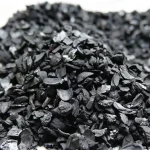
Fruit shell activated carbon
Fruit shell water purification activated carbon is made from high-quality fruit shells such as apricot shells, peach shells, walnut shells, and jujube shells, refined through a series of production processes, and appears as black granules. The advantages of fruit shell water purification activated carbon include a well-developed pore structure, large specific surface area, strong adsorption performance, low reservoir resistance, stable chemical properties, and easy regeneration. It is suitable for deep purification, dechlorination, decolorization, deodorization, and gold extraction in high-purity domestic drinking water, industrial water, and wastewater treatment.
Iodine value: 500, 600, 800, 1000, 1200
Specifications: 0.5-1mm,1-2mm, 2-4mm, 3-5mm, 5-8mm
Fruit shell activated carbon
Guoke water purification activated carbon is made from high-quality fruit shells such as apricot shells, peach shells, walnut shells, and jujube shells, refined through a series of production processes, and appears as black granules. The advantages of Guoke water purification activated carbon include a well-developed pore structure, large specific surface area, strong adsorption performance, low bed resistance, stable chemical properties, and easy regeneration. It is suitable for deep purification, dechlorination, decolorization, deodorization, and gold extraction in high-purity domestic drinking water, industrial water, and wastewater treatment.
There are many types of activated carbon used in the production of fruit shell water purification activated carbon. It is generally made into powder or granular form. There are apricot shell activated carbon, peach shell activated carbon, walnut shell activated carbon, and jujube shell activated carbon.
Fruit shell activated carbon is widely used in the deep purification of drinking water, industrial water, and wastewater, as well as gas phase adsorption. It is applied in various industries such as power plants, petrochemicals, refineries, food and beverage, sugar and wine production, pharmaceuticals, electronics, fish farming, and maritime transportation for water purification treatment. It can effectively adsorb free chlorine, phenol, sulfur, and other organic pollutants in water, especially precursor substances of mutagenic substances (THM), achieving purification, impurity removal, and odor removal. It can also be used for industrial exhaust gas purification, gas desulfurization, petroleum catalytic reforming, gas separation, pressure swing adsorption, air drying, food preservation, gas masks, deodorizing carriers, industrial solvent filtration, decolorization, purification, etc. It is suitable for the separation, purification, and purification of various gases; organic solvent recovery; decolorization, deodorization, and refining of sugar, monosodium glutamate, pharmaceuticals, alcohol, and beverages; precious metal extraction; catalysts and catalyst carriers in the chemical industry. The product possesses functions such as decolorization, purification, impurity removal, deodorization, odor removal, carrier, purification, and recovery.
- During transportation, fruit shell activated carbon should be prevented from mixing with hard substances, and it should not be stepped on or trampled to avoid crushing the carbon particles and affecting its quality.
- The storage should be done with porous adsorbents, so during transportation, storage, and use, it is essential to prevent water immersion, as water immersion will fill the active voids with a large amount of water, rendering them ineffective.
- When using activated carbon from fruit shells to prevent tar-like substances, it is important to prevent these substances from entering the activated carbon bed, as they may clog the pores of the activated carbon, rendering it ineffective in adsorption. It is recommended to use a tar removal device to purify the gas.

Engineering Case
inquiry
If you wish to submit a formal inquiry, please complete the following form.
Note: Fields marked with * are required.