
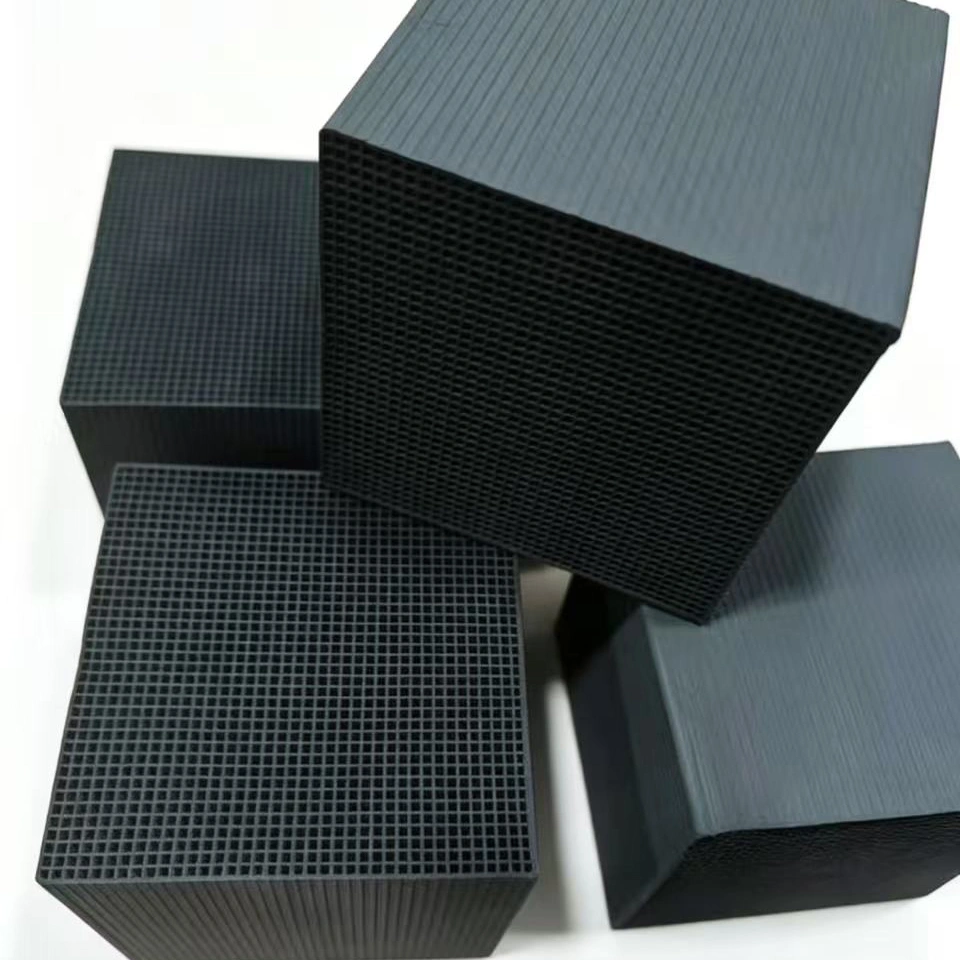
Honeycomb activated carbon
Honeycomb activated carbon is made from 70% activated carbon, 17% sepiolite, and 13% kaolin using ceramic technology. That is, the three raw materials undergo weighing, ball milling, screening, stirring, mud pressing, mud kneading, aging, mud kneading, extrusion molding, drying, calcination, inspection, packaging, and storage. This activated carbon has the advantages of water resistance, acid resistance, alkali resistance, high strength, large specific surface area, etc., and can be widely used in environmental protection, pharmaceutical, food, and other industries as well as as a catalyst carrier.
Ordinary honeycomb activated carbon, waterproof honeycomb activated carbon
Iodine value: 300, 400, 500, 600, 800
Specifications: 100x100x100;100x100x50
Product Introduction
Nest-shaped activated carbon is made of 70% activated carbon, 17% sepiolite, and 13% kaolin through ceramic technology. That is, the three raw materials undergo weighing, ball milling, screening, mixing, mud pressing, mud kneading, aging, mud kneading, extrusion molding, drying, calcination, inspection, packaging, and storage. This activated carbon has the advantages of water resistance, acid resistance, alkali resistance, high strength, large specific surface area, etc., and can be widely used in environmental protection, pharmaceutical, food, and other industries, as well as as a catalyst carrier.
Divided by shape: block activated carbon, square activated carbon, rectangular activated carbon, round honeycomb activated carbon. Divided by usage environment: ordinary honeycomb activated carbon, waterproof honeycomb activated carbon. Divided by purpose: small block activated carbon, activated carbon filter mesh, ceramic filter mesh, refrigerator deodorizing activated carbon block, toilet deodorizing activated carbon block, fish grill deodorizing activated carbon block, square-hole honeycomb activated carbon, round-hole honeycomb activated carbon, sponge activated carbon, air purification activated carbon, powder activated carbon, gas-phase honeycomb activated carbon, liquid-phase honeycomb activated carbon, coal-based columnar activated carbon, net-like activated carbon, flake-like activated carbon, oval activated carbon block. Customized activated carbon products in various shapes according to customer requirements
Honeycomb activated carbon can be widely used in various gas purification equipment and waste gas treatment projects. Practice has proven that its purification effect is better than that of ordinary activated carbon. Pollutants that can be removed to varying degrees using honeycomb activated carbon include: nitrogen oxides, carbon tetrachloride, chlorine, benzene, toluene, dimethylbenzene, propylbenzene, acetaldehyde, acetone, methanol, acetic acid, ethyl esters, ethylene, phosgene, odor gases, and other acidic and alkaline gases.
It can be used directly or installed in purification cabinets and adsorption beds. If the exhaust gas concentration is high and the emission volume is large, two purification cabinets and adsorption beds can be used in rotation. During use, excessive temperature should be avoided as it will reduce the adsorption capacity, which decreases as the temperature rises. At the same time, high dust content and oil mist should be avoided, as tar dust can block the micropores of activated carbon, increase resistance, and reduce adsorption efficiency. If the usage environment contains a large amount of thick dust and tar, a pre-stage dust removal filter should be installed to achieve good usage effects and a long service life. Product characteristics: It is widely used in various organic exhaust gas purification systems with low concentration and high air volume. The treated exhaust gas can fully contact with activated carbon when passing through the square holes of honeycomb activated carbon, achieving an adsorption efficiency of up to 67.16%. With a small wind resistance coefficient, it has excellent adsorption, desorption performance, and gas dynamic properties, and can be widely used for purifying various organic gases such as benzene, toluene, xylene, and other benzenes, phenols, lipids, alcohols, aldehydes, malodorous gases, and gases containing trace metals. The environmental protection equipment used has high exhaust gas treatment and purification efficiency, small adsorption bed volume, and low equipment energy consumption, which can reduce construction and operating costs. The purified gas fully meets environmental emission requirements.

Engineering Case
inquiry
If you wish to submit a formal inquiry, please complete the following form.
Note: Fields marked with * are required.